

Measles is Spreading: What to Know About the Symptoms and the Vaccine
As reports of measles outbreaks in the U.S. continue, a pediatric infectious disease physician shares how to protect yourself from the virus and what to do if you’ve been exposed.
In 2025, there were 2,281 confirmed cases of measles in 44 states and New York City – the largest number of cases since 2000, when the disease was declared eliminated in the U.S. This year, measles continues to spread, with over 1,100 confirmed measles cases reported in just the first two months of 2026 and outbreaks in South Carolina, Utah and Arizona, putting the country on the brink of losing its measles elimination status. The vast majority of measles cases in the U.S. occur in people who are unvaccinated.
“Measles is one of the most infectious viruses that exists,” says Dr. Irene Frantzis, pediatric infectious diseases doctor at NewYork-Presbyterian Morgan Stanley Children’s Hospital of Children’s Hospital of New York. “If you had 10 unvaccinated people in a room and a person walked into that room with measles, nine of them would get measles.”
Dr. Frantzis spoke to Health Matters about how serious measles can be, what to do if you think you or a loved one has been exposed to measles, and how you can help keep measles from spreading to others.

Dr. Irene Frantzis
How does measles spread?
Measles spreads through the air when an infected person coughs or sneezes. Measles has a nasty trick — it’s a very, very small particle that can remain suspended in the air upward of two hours after an infected person leaves the area.
What does the measles rash look like?
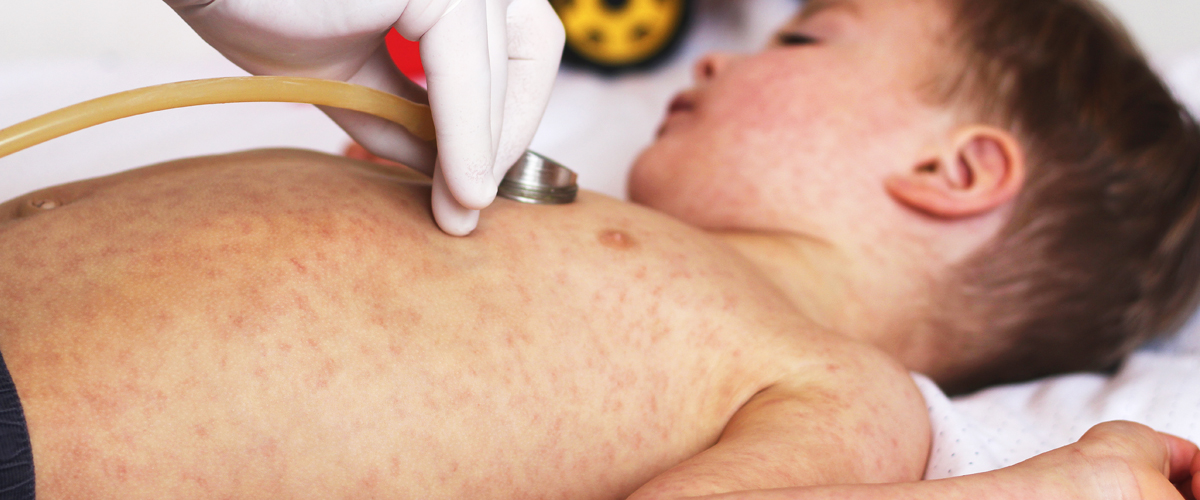
The measles rash appears 3-5 days after the initial cold-like symptoms. The rash starts off as red spots which are sometimes raised. The spots then join to form red, blotchy patches. Measles can look like other common childhood rashes, but it typically starts on the face or behind the ears and then spreads to the rest of the body.
What are Koplik spots?
Koplik spots are clusters of small white spots on the inside of the cheek near the molars that can sometimes appear early on in measles infection, usually before the rash comes on.
Who is most at risk of measles?
Unvaccinated individuals, babies under the age of 1 who are too young to get vaccinated, and immunocompromised people who have a weakened immune system are most at risk for getting measles. Immunocompromised can mean people who cannot be immunized because of an underlying medical condition, or people who were vaccinated but lost their immunity due to a condition like HIV.
We also worry about unimmunized pregnant individuals who, if infected, are at increased risk of miscarriage or preterm labor or preterm birth.
We mostly hear about children when there are reports of outbreaks. What about adults?
Adults who are unvaccinated or didn’t get measles as a kid are just as likely to get measles as children who are unvaccinated. But measles often spreads among children because it’s more likely that they are unvaccinated.
What are the symptoms of the measles?
Measles starts as an infection inside the lungs and then it moves throughout the body. The first symptoms are a fever that can get quite high, 103 to 105 degrees, a cough, a runny nose, and red, watery eyes. After having those symptoms for 2-4 days, a rash occurs that typically starts at the hairline, spreads over the face, then over the rest of the body.
How long is measles contagious?
People are infectious four days before the rash appears and four days after the rash appears.
What are the potential complications of measles?
Some people think that all that happens with measles is that you get some spots and a little bit of a runny nose, but it’s not that way for everyone. There can be very serious health complications from measles, including:
- Pneumonia (about 1 in 20 children)
- Diarrhea (about 1 in 10 people and can lead to significant dehydration)
- Ear infections (about 1 in 10 people and can lead to permanent hearing loss)
- Brain infection and inflammation (about 1 in 1,000 people can lead to permanent brain damage)
Those most at risk of these complications from measles are non-immune children younger than 5 years old, non-immune adults older than age 20, non-immune pregnant women, and immunocompromised people.
Can people die from measles?
An estimated one to three of every 1,000 children who get measles will die from respiratory or neurologic complications. Pneumonia is the number-one cause of death in children with measles. Measles can also hide in the brain and can cause a very rare, but deadly, form of brain infection that occurs seven to 10 years later and leads to seizures and a complete loss of mental and physical capacity. This complication is fatal.
Is the measles vaccine safe?
The measles vaccine is very, very safe and very, very effective. If someone gets two doses of the measles vaccine, that person will be about 97% protected.
How long does the measles vaccine last?
Measles immunity is lifelong after you’ve received two doses of the vaccine.
When can infants and young children get the measles vaccine?
The American Academy of Pediatrics (AAP) recommends a two-dose measles-mumps-rubella (MMR) vaccine series for children, with first dose at 12–15 months old, and the second dose between 4 and 6 years of age.
How about adults? What if you were born before the vaccine was introduced or when there was only one dose?
Adults born before 1957 can be considered to be immune because nearly all children got measles by the time they were 15 years old before the vaccine was introduced in 1963. Adults born in 1957 or later without documentation of having received their measles vaccine should receive at least one dose of the vaccine.
Adults vaccinated between 1963 and 1967 may have received the killed measles vaccine, which was less effective. They should talk with their doctor about getting revaccinated with the current live measles vaccine.
Some adults who are in a setting with a high risk for measles transmission should make sure to have two doses of measles vaccine, as opposed to one. These include college students, healthcare personnel, international travelers.
If I’m not sure whether I’ve been vaccinated, should I get the measles vaccine again?
There are two things you can do:
- Get one or two doses of the measles vaccine. There is no harm in getting vaccinated again. If somebody had two doses as a child and then gets another dose as an adult, that’s safe.
- A blood test called measles IgG. It measures the antibody produced by your body to measles that is considered protective against measles. So if you are measles IgG positive, it means you are protected and immune.
How is measles treated?
There are no antivirals or antibiotics for measles. Many people who get measles won’t need to see a doctor. They will be able to stay home and take Tylenol for the fever, use something to soothe their throat, and drink fluids to make sure they don’t get dehydrated.
Some people will have serious complications and need to be hospitalized to receive supportive care, including oxygen and machines to help with difficulty breathing from pneumonia or intravenous fluids to treat dehydration from diarrhea. Hospitalized children with severe measles can receive Vitamin A supplementation to help prevent severe complications.
Can post-exposure prophylaxis (PEP) prevent measles?
Yes. People who are not vaccinated for measles should receive the measles vaccine within the first three days after exposure to prevent measles infection. For people who cannot receive the measles vaccine, such as infants under 6 months or people who are severely immunocompromised, an infusion or injection with antibodies (called immunoglobulin) is offered to help prevent measles.
What should you do if you or your child has been exposed to measles?
If you or a family member has measles symptoms and you know there was an exposure to measles, call your doctor’s office immediately and tell them what happened. It’s important to call first because there could be little babies in the waiting room who have not yet been immunized. If you choose to go to an urgent care center or emergency room, call first so arrangements can be made to appropriately isolate you or a family member and protect others from being exposed.
Are there concerns with international travel?
If somebody is planning international travel, they should speak to their doctor and review the measles immune status of every person in their family. Measles remains a common disease throughout the world including Europe, the Middle East, Asia and Africa. This means that you really want to make sure that everybody is vaccinated, and that even includes very young babies.
The AAP now recommends that infants 6 to 11 months old should receive one dose of the measles vaccine before international travel, even though we don’t usually vaccinate such young babies.
Aside from getting the measles vaccine, what else can people do to stay safe?
The bottom-line message is to get vaccinated. It protects you, but it also creates a cocoon around people who can’t be vaccinated, thereby protecting them.