

What is Stage 0 Breast Cancer?
An expert explains what to know about ductal carcinoma in situ (DCIS), a Stage 0 breast cancer that is on the rise.
Of the 317,000 people who are diagnosed with breast cancer every year, about 20-25% of them will receive a diagnosis of ductal carcinoma in situ (DCIS), also known as Stage 0 breast cancer.
This form of breast cancer is an early-stage carcinoma in which the cancer cells remain in the ducts. “Women with a history of DCIS represent about 25% of all breast cancer survivors in the United States – that’s about a million people with a history of DCIS,” says Dr. Emily Tonorezos, a general internist in hematology/oncology at NewYork-Presbyterian/Weill Cornell Medical Center. “The numbers are increasing in part because the mammogram is more widely used as a tool, and it’s gotten to be a better test, so it can more easily pick up early-stage cancers.”
“DCIS is highly treatable,” says Dr. Tonorezos. “And because the most common symptom is no symptoms, it highlights the importance of early screening.” Health Matters spoke with Dr. Tonorezos to learn more about this early-stage cancer, including symptoms, risk factors, and treatment options.

What is Stage 0 breast cancer?
Stage 0 breast cancer is known as ductal carcinoma in situ. I usually explain each word to my patients: The duct is the part of the breast where the milk travels from the gland out to the nipple. Carcinoma means abnormal cells or cancerous cells. And “in situ” means inside. So it’s very important to remember that it’s abnormal cells, but they’re completely confined to inside the duct. It’s a non-invasive form of breast cancer.
What does it mean for cancer to be non-invasive vs. invasive?
The difference in the pathology is that Stage 0 stays inside, and Stages 1 through 4 are invasive, meaning the cells have broken out of the duct and gone into the breast tissue that surrounds the duct. Stage 0 cancer doesn’t travel to other parts of the body, so we don’t see it in the lymph nodes, in the brain, or in the bones, which are the common areas where breast cancer spreads.
What are the risk factors for DCIS?
Risk factors for DCIS are mostly the same risk factors for invasive breast cancer, and most are related to your exposure over your lifetime to hormones: the earlier the age when your period starts; the later the age of menopause; the later the age of first pregnancy.
Then there are risk factors related to inherited genetics, like the BRCA1 or 2 mutation, and family history of breast cancer. Smoking and alcohol use also increase your risk of breast cancer. And there are some non-cancerous conditions that can be found on breast biopsy that increase your risk of breast cancer, such as atypical ductal hyperplasia and atypical lobular hyperplasia.
What are the symptoms of DCIS?
Most commonly, people don’t have symptoms. But sometimes people might notice a lump, nipple discharge, or a change in the skin, such as a dimple or a ripple in the skin of the breast, which can indicate that there’s something going on underneath.
How does someone get diagnosed with Stage 0?
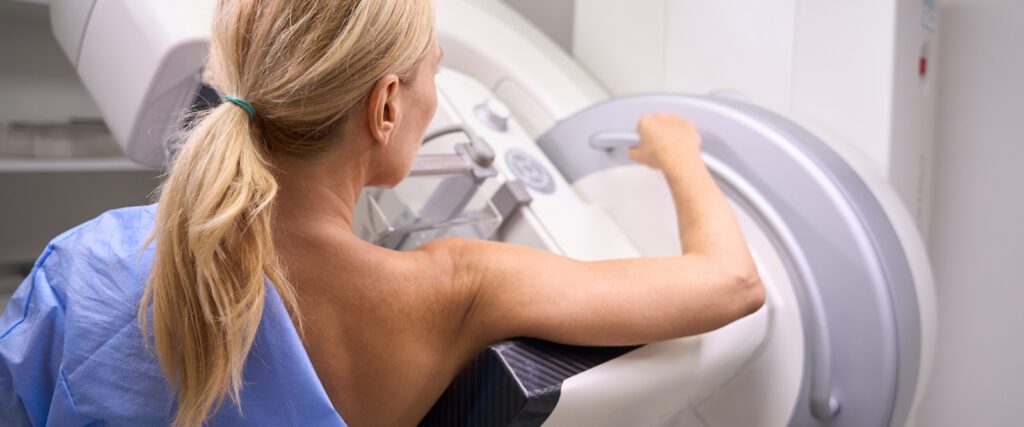
There are two main ways women get diagnosed with DCIS. The most common way is through a screening mammogram. Often these are people who don’t have symptoms and feel healthy, but the mammogram picks up something, such as calcium, which could be a sign of DCIS. A biopsy is then recommended, and the diagnosis is made. A smaller proportion of women can have a lump that turns out to be DCIS. Usually under those circumstances, a woman will have a diagnostic procedure, like an ultrasound or a diagnostic mammogram, which then leads to a biopsy.
What are the treatment options?
The most common treatment is surgery to remove the DCIS, usually followed by radiation, and then the option of endocrine, or hormonal, therapy, if you’re eligible.
Most of the time, there’s a discussion between the surgeon and the patient about whether they want to pursue local therapy, which would be a lumpectomy, or a mastectomy, where the entire breast is removed. For example, a surgeon might recommend mastectomy if they find several spots with DCIS, because it is more difficult to have a good cosmetic result with multiple lumpectomies. Some women may choose to have mastectomy because they typically won’t need to undergo radiation or endocrine therapy afterwards. It might feel like a more definitive option for some patients, though it’s a larger surgery with a longer recovery.
There is also an emerging population of women who choose to have active surveillance, which is a way to monitor people after a DCIS diagnosis without doing surgery, radiation, or endocrine treatment.
The COMET trial, a recent study of patients with low-risk DCIS, found that patients who were under active surveillance had the same rate of developing an invasive cancer after two years as those who chose upfront treatment, including surgery. So if a patient needs to be on active surveillance for a one- to-two-year period, that is probably a reasonable approach for a short period of time. But we need more longterm data to know which patients or which situations are best suited to surveillance.
Does Stage 0 always progress to a more advanced stage of cancer?
The main reason to treat DCIS is to keep it from either turning into invasive breast cancer or to lower your risk of a new invasive breast cancer in the future. Currently, we do not know which DCIS is going to turn into something more aggressive, and which could be left alone and never cause the person a problem.
There are some features in the pathology report, like grade, that can be helpful in determining the risk of invasive breast cancer. But more research is needed to figure out what’s going to be a problem and what isn’t.
What are the outcomes for people diagnosed with Stage 0?
Stage Zero is not life-threatening. The goal of treatment is to prevent invasive breast cancer, and of course to try to minimize side effects from treatment. The majority of people diagnosed with DCIS go on to live long healthy lives.
What can people with DCIS do to prevent recurrence?
The risk of recurrence of DCIS after treatment is extremely low. The risk of a new DCIS or an invasive breast cancer depends on many factors, but increases if you’re younger at the time of diagnosis, if the pathology says high grade or necrosis, if your surgical specimen has close margins, and if you don’t get radiation therapy.
It’s very important to talk to your team about the option of endocrine therapy. If the breast cancer is hormone receptor positive, endocrine therapy will lower estrogen in the breast, which decreases the risk of a new DCIS or invasive breast cancer.
We know that exercise, including aerobic exercise, a plant-based diet, and avoiding tobacco and alcohol all lower your risk of breast cancer. People with a history of DCIS should also be sure to continue their regular screening. There is a lot that you can do to lower your risk.
Emily Tonorezos, M.D. M.P.H. is a general internist in hematology/oncology who specializes in DCIS and cancer survivorship at New York-Presbyterian/Weill Cornell Medical Center. She is also a Clinical Associate Professor of Medicine in the Division of Hematology and Medical Oncology at Weill Cornell Medicine.