

How to Manage Food Allergies in School: A Guide
A pediatric allergist shares tips on how to help children with food allergies stay supported and healthy through the school year.

As the new school year approaches, families of children with food allergies are preparing for the return to the classroom. In the U.S., an estimated 1 in 13 children, or two per classroom, are affected by food allergies, according to the Centers for Disease Control and Prevention. Eight foods account for the most serious reactions — peanuts, tree nuts, milk, egg, soy, wheat, fish, and shellfish.
For many caregivers, especially those whose children have experienced a severe allergic reaction like anaphylaxis, back to school time can bring a mix of anxiety and uncertainty. But with the right planning, they can worry less about food allergies and instead just focus on school.
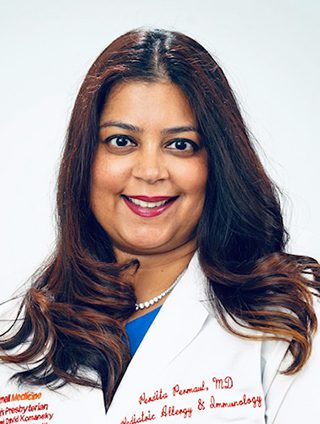
“There is no need to be fearful or anxious,” says Dr. Perdita Permaul, a pediatric allergist and immunologist at NewYork-Presbyterian Komansky Children’s Hospital of Children’s Hospital of New York. “The key is being prepared. How do you do that before school starts? Be well versed on your child’s food allergy and have a plan in place.”
Health Matters spoke to Dr. Permaul about how to help children with food allergies stay supported and healthy throughout the school year.
If your child has food allergies, what should you do over the summer to prepare for managing them at school?
The first thing to do is contact the school and be clear on the school’s guidelines for managing a food allergy. Parents should always advocate for their kids and talk to the school about the child’s different needs during the day.
Also make an appointment with your allergist early, so you have prescriptions, a food allergy anaphylaxis management plan, and medical forms set for the school year.
Who should you contact at the school about your child’s food allergy?
- The school nurse will be your main resource to provide medical information and instructions, and they will administer the emergency medication if it is needed.
- The classroom teacher is the person who will be there day to day and should also be trained to give medications in the event of an emergency. You can ask them about where food is kept in the classroom, where the children will be eating, who is overseeing meals or snacks, and the rules for birthday parties and field trips, so you can plan in advance to bring food for your child. Hand washing should be done after eating or handling food in the classroom. And there should be no food sharing — that is a must and should be enforced.
- The cafeteria manager or cafeteria volunteers should be aware of the food allergy. They will know how the school food is being prepared and if there may be any risk of cross-contamination.
- The transportation coordinator is important to know if your child takes the bus. Ask if an adult or paraprofessional will be on board in case of an emergency, especially if you have a younger child.
How should you prepare for a food allergy emergency at school?
Every child who has a food allergy needs an anaphylaxis management plan. Along with the emergency care plan, there should be medications on hand. The school should have a two pack of epinephrine auto-injectors for the child, and the prescription needs to be updated before school starts because it expires every year. As a caregiver, you should know who will administer the epinephrine injector at school.
What are some tips to help your child take responsibility for having a food allergy at school?
Teach your child to advocate for themselves. There are ways they can communicate their allergies to their teachers, their friends, their school staff. It can simply be, “I have a milk allergy, and I can’t eat foods that contain milk. I need to look at the labels first.”
As soon as your child is able, have them read ingredient labels themselves. A lot of our food allergy kids are really savvy. Once they’ve had an allergic reaction, they know they don’t want another one. So, they instinctively advocate for themselves, and if they don’t know what’s in there, they won’t eat it.
What if they are anxious about being bullied at school for having a food allergy?
I always tell parents to have an open line of communication with your child. Talk to them about their food allergies, if they’re experiencing any bullying at school, if they’re feeling isolated, or if they’re having anxiety or fear.
Also, reach out to other families and explain why you have to limit your child. If you’re a parent with a food allergic child and have gone through anaphylaxis — which is pretty scary stuff — telling other parents about the experience might make them a little bit more empathetic.
And if your child is really struggling, find a food allergy support group or speak to a mental health professional. Some children may develop eating disorders because of food anxiety or just don’t eat because they’re scared. In our clinic, we have a food allergy psychologist who works with our patients, which is ideal.
What are some safe snacks for kids with food allergies to bring to school?
Foods like fruits and veggies, dried fruit or fruit strips, turkey sticks or other kinds of jerky are great for snacks. If the child isn’t allergic to corn or rice, rice cakes, plain or lightly salted popcorn, or corn chips with salsa or guacamole, are also safe options.
When should you have your child tested for food allergies?
Parents are usually hypervigilant when it comes to allergic reactions. It’s important to know that food allergic reactions don’t happen hours after ingestion. It’s usually immediate, within minutes up to 1 hour after ingestion. A child may start to experience hives and complain about oral symptoms, like an itchy mouth or throat and swollen lips. Other signs are breathing difficulties like an asthma attack as well as immediate vomiting.
For a diagnosis, an allergist will do skin testing for the foods in question, and if there is an allergy, you will be given a prescription for an epinephrine auto-injector, along with a food allergy anaphylaxis management plan.
Are there treatments for food allergies people should consider?
The only way to prevent an allergic reaction is strict avoidance of the food and carry your epinephrine.
As for current therapies, the biggest one would be food oral immunotherapy (OIT), which is meant to desensitize the immune system so that the body does not react to the problem food. This should be done under the guidance of a board-certified allergist and involves feeding micro-doses of the food allergen in the office to make sure that the child can tolerate it. The child then consumes daily at home until the next up-dosing office visit. Over time, they increase the amount of food so the child builds a tolerance. OIT may not allow all children to freely eat the food but in some cases it may. More importantly, if there is an accidental exposure, it protects the child from a severe allergic reaction.
A newer treatment, which was FDA-approved in February 2024, is Omalizumab (brand name Xolair), a type of biologic medicine administered as an injection under the skin that targets and reduces immunoglobulin E (IgE), the allergic antibody responsible for severe allergic responses. It was originally approved in 2003 for treatment of moderate to severe asthma, in 2014 for chronic hives, and in 2020 for chronic sinusitis with nasal polyps. Recent clinical trials found that omalizumab also reduces severe allergic symptoms with small exposures to food allergens. It is not curative, so you still have to avoid the food and carry your epinephrine autoinjector, but it adds another layer of safety for those at risk for food anaphylaxis.
If your child has food allergies, how often should they go to the allergist?
It depends on the food, but typically, at least every six months. We know that certain foods can be outgrown more than others. About 85% of patients who have milk, egg, soy, and wheat food allergies will outgrow the allergy. When it comes to peanuts, 20%, and tree nuts, about 10%. For the children with food allergies that are less outgrown, we should see them at least on an annual basis, more frequently if they are on food allergy treatments.
Additional Resources
- Learn more about comprehensive, pediatric allergy care at NewYork-Presbyterian.