

Cataracts: Causes, Symptoms, and When to Get Cataract Surgery
An ophthalmologist explains what causes cataracts and the best ways to treat them, including the latest advancements in treatment.
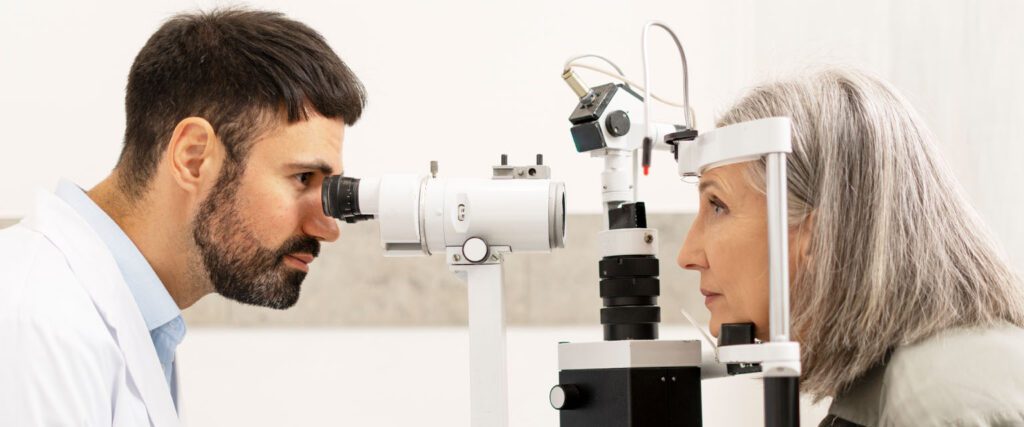
More than half of Americans over the age of 80 either have cataracts or have been treated for the condition. Cataracts are a painless, cloudy area in the lens of the eye that blocks the passage of light to the retina. As a result, people experience vision changes, including blurry vision or issues seeing at night.
“Most of the time, cataracts are caused by aging and can start to develop very gradually as early as your 50s to 60s,” says Dr. Leejee Han Suh, an ophthalmologist at NewYork-Presbyterian/Columbia University Irving Medical Center and the Director of the Cornea Service at Columbia.
The good news is that cataract surgery is a highly effective procedure for patients to undergo. More than 26 million cataract surgeries are performed every year.
“It’s normal to feel anxiety around getting it treated,” says Dr. Suh, “but cataract surgery is safe, effective, and more personalized now than ever.”

Health Matters spoke with Dr. Suh to learn more about cataracts, when it is time to consider cataract surgery, and the types of treatment that are available.
What causes cataracts?
Everyone develops cataracts at some point, with age being the most common cause, but they can also occur when someone experiences trauma to the eye (called traumatic cataracts), as result of certain conditions, such as uncontrolled diabetes, or a reaction to certain medications like chronic steroid use. Some people are born with congenital cataracts. Chronic exposure to UV light can also contribute to the development of cataracts.
What are the most common symptoms of cataracts?
One of the earliest symptoms of cataracts is sensitivity to light. For patients who drive a car, they may notice that driving at night may become more difficult due to glare. It might become harder to read in dimly lit environments.
Other symptoms of cataracts include:
• Cloudy, fuzzy, or foggy vision
• Sensitivity to lights, such as lamps and car headlights
• Trouble seeing at night
• A glare or “halo” effect around lights
• Seeing colors as faded or not as vivid
• Frequently having to change glasses or contact lens prescription
How are cataracts diagnosed?
It can be difficult to know if someone has cataracts without an eye exam, so seeing an eyecare provider is the first step. Many people who already wear glasses or contacts get diagnosed with cataracts when they are already getting an eye exam with their regular eyecare provider.
Are there any lifestyle choices that may prevent cataracts from developing or worsening?
Maintaining a healthy diet, exercising, not smoking can all help slow down the progression of cataracts. I tell my patients, “If it is good for your heart, it is good for your eyes.” It’s also important to wear wear UV-block sunglasses when outdoors, even on cloudy days.
When should patients consider cataract surgery?
In the early stages, if the cataract is causing a change in your eyeglass prescription or contact lens prescription, changing your prescription may help. But at a certain point, even stronger prescriptions will not help you see better. Once someone’s cataracts are getting in the way of their daily activities, such as driving, reading, and watching TV, it is usually time to seek care and consider surgery.
How are cataracts treated?
Cataracts can only be cured with surgery, during which an eye surgeon essentially removes the cloudy lens and replaces it with a new artificial lens implant called an intraocular lens (IOL). The choices for implant replacement have really widened over the years, so cataract surgery is not a “one-size-fits-all” type of surgery; we work with patients to create a personalized approach based on their individual needs and goals.
When considering surgery for cataracts, there are two main choices the patient needs to make: first, what type of surgery, and second, what type of lens replacement.
There are two main types of surgery:
• Standard cataract surgery (also known as phacoemulsification), is the traditional option. The surgeon uses a blade to make an incision on the eye, then uses an ultrasound probe (phacoemulsifier) to break up the cataract into little pieces, which are then removed, and then the surgeon implants an IOL. This type of cataract surgery is covered by most insurance providers.
• Femtosecond laser-assisted cataract surgery (FLACS) is a newer technique (approved in 2011) which uses a femtosecond laser that is programmed to make incisions on the cornea, including incisions to help reduce low levels of astigmatism, and break up the original lens. The laser platform also provides a real time cross-sectional image of the cornea and lens so the surgeon can assess the depth of the cataract. The surgeon then completes the rest of the procedure manually to remove the cataract pieces, similar to the traditional phacoemulsification technique, and implant the artificial lens. This type of surgical approach can be considered outside of insurance coverage.
There are four main types of lenses:
• Monofocal lenses, the most common option and covered by insurance carriers, are fixed-focus lenses that allow you to see clearly at either a far or near distance, but not both. So, if you are left farsighted, you will be more dependent on reading glasses. If you are left nearsighted, you will be more dependent on distance glasses.
• Multifocal lenses allow you to see clearly for both far and near, with less dependence on glasses. Some patients experience halos at night especially during night driving. Not all patients are candidates for multifocal implants as you cannot have other eye conditions like retinal diseases or glaucoma. Your surgeon will determine candidacy at the time of your eye examination.
• Toric lenses help correct higher levels of corneal astigmatism. Your corneal astigmatism is measured at the time of your eye examination.
• Extended depth of focus (EDOF) lenses are a newer option that enhance vision for reading. These implants allow less sharp near vision than the multifocal lenses.
Artificial lens replacement is permanent and does not require further replacement as the implants are made of plastic and stay clear in the eye indefinitely.
What are some common side effects of cataract surgery?
Common side effects include eye redness, a feeling of irritation or “grittiness” in the eyes, and blurred vision, which usually subside within a few days to weeks. The long-term effects of both types of surgical approaches are very similar.
Avoid aggressive exercise, such as running or heavy lifting, for at least two weeks after surgery and avoid getting your eyes wet or applying any pressure for the first few days.
Are there patients who should avoid cataract surgery ?
Patients must be healthy enough to undergo local anesthesia for cataract surgery. This is determined by the patient’s internist, primary care physician, or another specialist.
What do you tell patients who are nervous about eye surgery?
For both types of cataract surgery, pain is usually very minimal as the eye is anesthetized, and the patient is given some intravenous sedation to help calm them.
I have seen cataract surgery completely transform patients’ lives. There are even studies that have shown cataract surgery can extend your life because you remain active longer. In order to figure out which approach is best for you, it is important to have a conversation with your doctor so that we can create a treatment plan based on your individual needs.