

Caring for Two Generations
With pioneering innovations in diagnosis and treatment for retinoblastoma, the ophthalmology oncology team at NewYork-Presbyterian/Columbia University Irving Medical Center gave a mother and daughter the gift of vision and hope for the future.
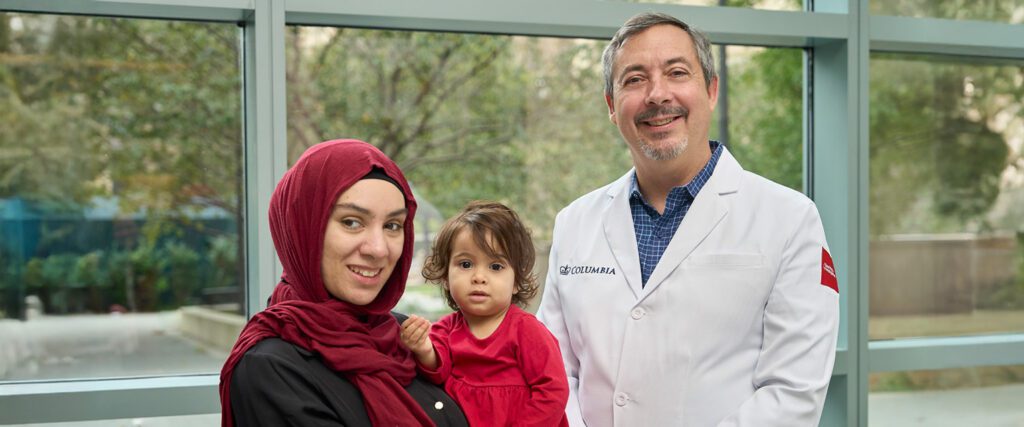
When Aliaa Nasser gave birth to her daughter Ghazelle, in May 2024, like most parents, she had a special newborn outfit picked out and introduced her to the overjoyed family, but she also had one unusual priority — to make sure Ghazelle got a thorough eye exam when she was two days old.
Aliaa knew her own history with retinoblastoma — a rare, hereditary eye cancer — would put Ghazelle at risk for the disease. So she brought Ghazelle to a pediatric ophthalmologist for monthly checkups since birth. “I did what I had to do for Ghazelle,” says Aliaa. “I decided I would rather be safe than sorry.”
During the first few visits, the doctor saw nothing concerning, until a small bump in Ghazelle’s eye appeared when she was two-and-a-half months old. That’s when Aliaa was referred to Dr. Brian Marr, an ophthalmologist at NewYork-Presbyterian/Columbia University Irving Medical Center who specializes in ophthalmic oncology.
At the first appointment, Dr. Marr asked Aliaa about her own personal journey with retinoblastoma. Aliaa, who was born in Philadelphia, told Dr. Marr that she was diagnosed when she was four-months-old and treated with chemotherapy. As they continued talking, Dr. Marr realized that he had been a young attending physician in ocular oncology at the hospital where Aliaa was treated as a baby, over 20 years ago — and he was part of Aliaa’s care team.
“It was quite a coincidence,” says Dr. Marr. “She was coming back to the person who treated her as a kid and then entrusting me to take care of her child.”
A Legacy of Expertise
When Dr. Marr checked Ghazelle’s eyes, he also saw the new tumor next to her center of vision, indicating she indeed had retinoblastoma.
Retinoblastoma is a rare but aggressive childhood cancer that almost exclusively affects infants and young children. Each year, about 300 to 400 cases of retinoblastoma are diagnosed in the U.S., and an estimated 8,000 worldwide. The cancer develops in the early-forming cells of the retina, and as the tumor grows, it starts to impact the main structures in the eye. Left untreated, the tumor will fill up the eyeball, and in the most advanced cases, there is a risk of metastasis and death.
Retinoblastoma was the first cancer linked to a genetic mutation — a defect in the RB1 gene — and NewYork-Presbyterian has a unique place in the history of care. In the mid-20th century, Dr. Algernon Reese and Dr. Robert Ellsworth established the world’s first clinic dedicated to treating children with retinoblastoma at Columbia’s Harkness Eye Institute. At that time, retinoblastoma was almost always fatal, claiming the lives of 90% of children diagnosed. Today the odds have shifted entirely — there is a greater than 90% chance of survival.
“We’ve seen enormous progress in retinoblastoma in the past decades,” says Dr. Lauren Yeager, a pediatric ophthalmologist at NewYork-Presbyterian Morgan Stanley Children’s Hospital of Children’s Hospital of New York, who is a member of the ophthalmic oncology team. “Out treatment is much better; we’re able to save more eyes and vision in children.”
Dr. Marr now leads the retinoblastoma program, and patients are treated with a multidisciplinary approach. The team includes specialists from ophthalmic genetics, pediatric oncology, interventional neuroradiologists, pediatric ophthalmology, radiation oncologists, and diagnostic radiologists.
The program is also pioneering innovations in treatments, including new techniques that deliver chemotherapy treatment more precisely. Intra-arterial chemotherapy, which directs cancer-fighting drugs into the tiny blood vessels that feed the eye, has been especially effective for advanced tumors. Injections of chemotherapy into the eye are also now possible, further improving outcomes and vision preservation.
“At NewYork-Presbyterian, we have the top experience in treating this disease,” he says. “But it’s also about compassion and being there for patients. I think that’s what sets us apart.”
“The Ultimate Home Run in Treatment”
For Dr. Marr and his team, Ghazelle’s case was fortunate because the tumor was detected so early.
The first step for treating children at risk of retinoblastoma is an exam under anesthesia (or EUA) in the operating room. In this procedure, every corner of the eye is examined, leaving no part unseen.
Once the baby is under anesthesia and asleep, the pupils are dilated, and a speculum gently holds each eye open. Doctors look at the front of the eye with a light and magnifying glass. Using instruments, they check the eye pressure, the diameter of the cornea and inspect the retina. They also perform ultrasounds to evaluate the optic nerve, take high-resolution photographs of the retina, and even create detailed, colored-pencil drawings of the retina to refer to.
During Ghazelle’s exam, Dr. Marr confirmed she had small tumors in both eyes. One was located just beside the fovea — the pinpoint area of the eye that controls sharp, 20/20 vision. He decided to remove the tumors right away using a laser, which is a highly precise method. To laser the tumor, Dr. Marr wore a headset with the laser mounted onto it, heating up the laser just enough to kill the cancer, and target the tumor.
“You have to be exact, especially when it’s right next to the center of vision,” says Dr. Marr. “It’s really tricky because if you undertreat these tumors, they grow bigger, and the cancer comes back and you lose significant vision. If you overtreat, you involve the sensitive center area of the eye and lose significant vision.”
The entire exam and treatment only took about a half hour, but for Aliaa and her husband Faris, it seemed much longer. When Dr. Marr told them it was a success and they got rid of the tumors, Aliaa was overwhelmed. “It was a bunch of emotions,” she says. “It was hard not to feel sad knowing she got it from me, but I was really happy it was found and taken care of.”
“I think she felt relief, having walked through that experience herself and understanding what it meant for her daughter to be cancer-free,” says Dr. Yeager.
In the months that followed, tiny new tumors appeared, but each was caught early and eliminated with the same precise technique. Unlike Aliaa, who endured six rounds of chemotherapy as an infant, Ghazelle avoided chemotherapy and other treatment entirely.
“It’s like the ultimate home run in treatment for retinoblastoma, the best that could happen,” says Dr. Marr.
A Future Doctor
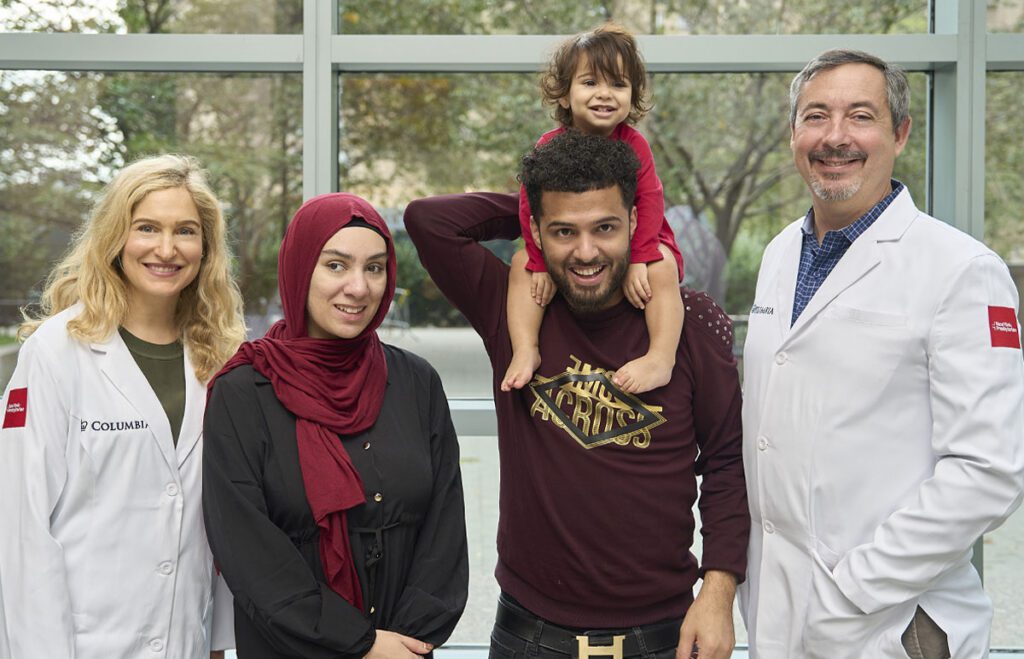
Today, Ghazelle is healthy, playful, walking and babbling. For Dr. Marr, seeing her thrive is a reminder of why he and the team do this work.
“A cancer diagnosis is terrifying for any family, and to be able to care for both a mother and her daughter — through the fear, through the treatment, through to this outcome — it’s really an honor,” he says.
Aliaa continues to be monitored by Dr. Marr in the NewYork-Presbyterian/Columbia retinoblastoma survivors’ clinic, which follows childhood patients into adulthood to screen for secondary cancers and provide lifelong care. And even though Aliaa has blocked vision on her right and left eye because of the chemotherapy and tumors she had as a child, she has big dreams for her future. From the time she was little, Aliaa remembers doctors showing her around their offices and teasing her that someday she would join their team. Sure enough, she is now completing her biology degree, with plans to pursue medical school.
“I love my doctors — I’m so grateful for them,” she says. “They gave me my eyesight, and they gave me hope, and they did the same thing for Ghazelle. I want to give that feeling back to people.”
Dr. Marr has encouraged her to pursue her dream. “She can work for me someday,” says Dr. Marr. “From newborn to fellowship, right? It’s not unreasonable. I think she’ll do it.”